
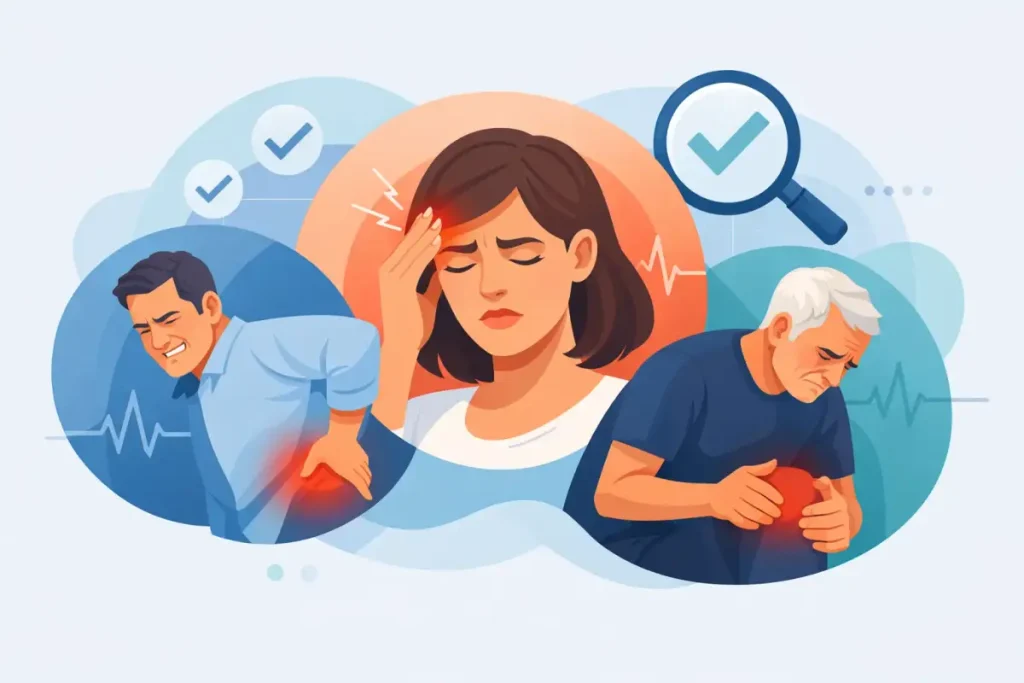
Anyone looking for “customer experiences pain treatment” rarely just wants to count stars. There is usually a specific moment behind it: the neck is hard again after a long day at work, the back reports when you get up or the exhaustion remains despite the end of the day. Then the question of whether an application changes noticeably in real everyday life counts – and not how good an advertising promise sounds.
Experiences are valuable, especially for pain and tension, but they have to be read correctly. What brings ease to a person after ten minutes can require several appointments for another person, an adjustment of everyday life or a medical clarification. Good customer reviews therefore not only show enthusiasm, but also for whom a method fits, how the process works and what expectations are realistic.
What customers really rate when it comes to pain treatment
People don’t just rate a technique. You evaluate the overall feeling before, during and after an appointment. In classical applications, it is often about the hands of the treating person, the pressure and the duration. In modern, non-contact concepts, other points are in the foreground: does the application feel pleasant? Is she uncomplicated? Can the appointment be integrated into a full day without much effort? And above all: How does the body feel afterwards?
Three situations are often repeated for feedback on back, shoulder or neck problems. Professionals describe the need for a brief reset between screen, sessions and commuting. People with physical work want relaxation without losing time again after a long treatment. Above all, others are looking for peace and quiet, better sleep and the feeling that the body is no longer constantly on tension after constant stress.
This makes customer opinions particularly meaningful if they remain concrete. “I felt better” is likeable, but says little. More helpful is feedback like: “After the session I was able to turn my head freer”, “My shoulders seemed less pulled up in the evening” or “I could fall asleep more easily.” Such statements describe a personal perception, not a medical guarantee. That’s exactly what makes them more credible.
Customer experiences with pain management classify
A single euphoric assessment may give hope, but it does not replace a factual assessment. Pain occurs for various reasons: overload, one-sided exercise, stress, lack of sleep, injuries or illnesses can work together. Therefore, it makes sense to use testimonials as orientation – not as a diagnosis and not as a promise that the same result will be achieved for every complaint.
Pay attention to patterns instead of superlatives. If several people report that they find the treatment deeply relaxing, uncomplicated and pleasant, this says something about the process. If several customers write that they feel more agile or recovered afterwards, this can be a good signal. Nevertheless, their starting position remains decisive: How long have the complaints lasted? What makes it worse? What have you already tried?
The course of time also deserves attention. Some people feel a change immediately after an application, others only notice the effect later – for example when the body feels calmer in the evening or sleep becomes easier. In the case of long-term tension, it often makes more sense to observe the development over several dates instead of making a final judgment after a session.
Caution is appropriate for statements that promise healing for every cause, permanent freedom from symptoms or a replacement for medical diagnostics. Serious pain relief is based on what you actually feel and what should be medically clarified. In the case of severe, sudden or increasing pain, feelings of numbness, paralysis, fever, shortness of breath or complaints after an accident, a medical clarification is the first priority.
Why short, non-contact sessions are mentioned so often
Not every person wants a manual massage. Some feel uncomfortable with direct contact, others don’t want to change for an appointment or simply don’t have time for long applications. Here is an advantage non-contact methods Particularly clear: You can stay fully clothed and the session is easier to incorporate into the week.
This experience is the focus of miracle massage. The application works with electromagnetic pulses and is designed for short sessions of about 10 to 20 minutes. Customers do not decide between a strenuous wellness program and not a break at all, but can consciously take a short window of time for physical relaxation.
That’s not detail. If you regularly don’t have enough time for yourself in stress or muscular tension, you need a solution that remains realistic in everyday life. The best approach doesn’t help much if it’s only implemented every few months. A short application can be attractive for people who are looking for a supplement to exercise, recreation and medically accompanied treatment.
The first appointment is a test, not a leap of trust
Good experiences start with a clear expectation. Do not go with the demand that every complaint must disappear immediately. Do you go with a specific question of observation: do the neck and shoulders feel more relaxed afterwards? Can I breathe more freely? Am I calmer inside? How is my body feeling in the evening or the next morning?
Before the appointment, it helps to assess the strongest complaint on a scale from 0 to 10. Briefly note where the tension is and what movement is uncomfortable at the moment. After the session, they not only compare the pain intensity. Also note mobility, restfulness, sleep quality and energy. These little observations are more meaningful than a vague “good” or “not good”.
Say openly if you are sensitive to stimuli, are unsafe or have a pre-existing condition. straight at implanted electronic devices, during pregnancy or in the case of relevant health questions, an individual clarification with the treating body and, if necessary, with a doctor, is required in advance. Security does not arise through silence, but through an honest assessment of one’s own situation.
When testimonials are particularly helpful
Customer reviews are strongest when their starting position is comparable. If you sit at your desk a lot, you will find yourself in reports about tense shoulders and heavy legs. Those who work physically may pay more attention to regeneration after exertion. People with stress-related restlessness often read carefully whether others could switch off or sleep better after a session.
However, compare not only the complaint, but also the goal. Some wish you a quick relaxation before an important appointment. Others want to work on their body feelings for weeks. Still others are looking for a pleasant, drug-free supplement because they were not satisfied with previous manual applications. One method can be appropriate for all of these goals, but the scale is different.
Critical feedback also has its value. Maybe someone’s effect was too subtle, the expectation too high, or the time unfavorable. This is no reason to write off the entire method. Rather, it shows that bodies react differently and that treatment cannot be evaluated in isolation from stress, sleep, exercise and medical history.
A good body can be concrete
Pain treatment is often only taken seriously when it sounds complicated. A sensible goal can be very simple: turn your head more easily, sit more relaxed, switch off better after a full day or stand up less stiffly in the morning. These changes are not small for everyday life – they create space for movement, concentration and quality of life.
Therefore, read experiences with an open view, but without blind trust. Choose an application that suits you, ask questions and give your body the chance to evaluate a new form of relaxation yourself. The most helpful scale is not the loudest rating, but what you really feel after the appointment.
The suitability is discussed individually before use. Results can vary. Miracle massage does not replace a medical diagnosis or prescribed treatment. The application is not carried out during pregnancy. Miracle Massage · Zurich

