
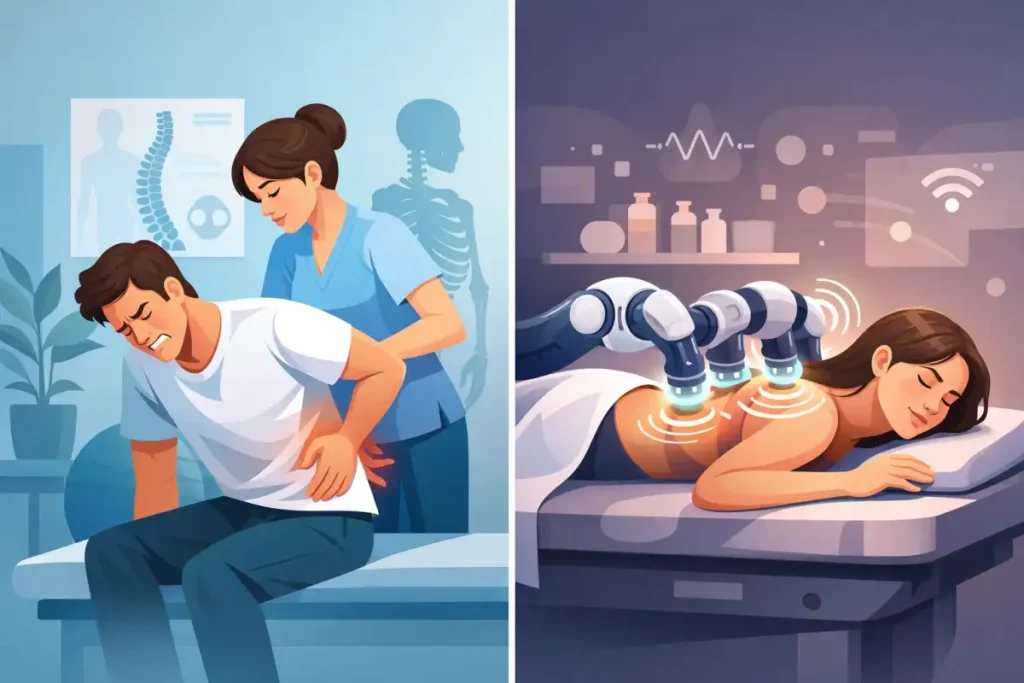
A tense neck after eight hours on the screen, pulling back after work or the feeling of never really being able to switch off: If you are looking for relief, you don’t want to wait weeks for an effect. At Physiotherapy versus massage technology it is therefore not about a general either-or. It’s about the question of what your body needs right now – targeted functional treatment, quick relaxation or a clever connection between the two.
Physiotherapy versus massage technology: the core difference
Physiotherapy is a medically oriented form of therapy. It is mainly used when movement is restricted, there is pain after an injury, an operation has an effect or a specific orthopedic, neurological or functional problem needs to be clarified and treated. The focus is on findings, movement analysis, active exercises and a treatment plan tailored to the respective situation.
Massage technology takes a different approach. Instead of manual grips or a training program, she works with technical stimuli that are intended to support relaxation and regeneration. At non-contact procedures Electromagnetic impulses are used like miracle massage while they remain fully clothed. A session is short, uncomplicated and geared towards a noticeably more relaxed body feeling.
The difference is not only in the method, but also in the goal. Physiotherapy is intended to build or restore function in a targeted manner. Technological applications are especially aimed at people who want to efficiently shut down tension, stress and physical overload – without moving, without prolonged manual treatment and without medication.
When physiotherapy is the right choice
In the case of a clear injury, after an operation or in the case of persistent symptoms with significant restricted movement, there is no way around a technical clarification. This also applies to feelings of numbness, loss of strength, suddenly severe pain, fever, unwanted weight loss or symptoms after an accident. Medical or physiotherapeutic diagnostic skills are required here, not just relaxation.
Physiotherapy has its strength where active participation is crucial. A therapist can observe movement patterns, dose loads, adjust exercises and accompany progress over several appointments. If you want to exercise safely again after a cruciate ligament tear, you have to regain mobility after a shoulder operation or want to tackle chronic back pain with targeted training, you benefit from this structured work.
However, this requires time and initiative. Exercises often have to be continued between appointments. In addition, a physiotherapy session is usually not a quick reset for an overflowing working day, but part of a longer rehabilitation or training process. This is exactly where their quality lies – and for some people also their hurdle.
What makes modern massage technology different
Many complaints do not arise from a single injury, but by constant tension: sitting for a long time, one-sided stress, lack of sleep, mental tension or a lack of recovery phases. The shoulders move up, the jaw stays firm, the back feels heavy. Anyone who knows this condition often looks for less training than quick access to deep calm.
This is where modern massage technology comes in. The application is non-contact and takes place clad. This can be particularly pleasant for people who do not like manual massages, feel uncomfortable with direct physical contact or do not want to plan a long appointment. In 10 to 20 minutes, a regeneration break can be integrated into a full everyday life – before work, during the lunch break or after physical exertion.
The key advantage is comfort. There is no creaming, no change and no pressure from hands on pain-sensitive areas. The impulses are perceived as part of a relaxation setting; How strong the effect is felt is individual. Some people report above all of a calmer feeling in the body, others of relaxed muscle groups or better recovery. However, this application does not replace a guarantee for healing or a medical diagnosis.
Efficiency is not a secondary topic
For many people in Zurich and the surrounding area, not only the method decides, but the feasibility. An effective plan quickly fails if it doesn’t fit into everyday life. Anyone who hardly finds any free dates between family, commuting, sports and work often postpones their own regeneration until a constant companion is the excitement.
A short technical application can significantly reduce this threshold. It is suitable as a regular break for people with screen work, physically demanding professions or stressful weeks. It’s not about downplaying physiotherapy. It’s about closing a gap: between the desire for immediate relief and the effort of a classic treatment.
The lack of touch is more than a detail. Some people find them more discreet, hygienic and more relaxed. Others prefer personal contact and targeted work of manual therapy. Both are legitimate. The decisive factor is whether you feel safe during the application and whether the method fits your expectations.
Which method suits your situation?
The best decision will be easier if you honestly look at your goal. Do you need rehabilitation, resilient training and a technical analysis of restricted movement? Then physiotherapy is usually the right first step. If, on the other hand, you are looking for uncomplicated relaxation after a hectic day, if you want to subjectively reduce muscle tension or consciously create time for regeneration, massage technology can be an attractive option.
A combination can be particularly useful. Physiotherapy gives direction and active exercises for specific functional problems. A non-contact regeneration application can also offer itself in phases of high stress if the body demands rest. It does not replace an individually prescribed therapy plan, but can help to establish relaxation as a fixed habit.
A quick security check is worthwhile before a first session. People with implanted electronic devices, during pregnancy, acute illnesses or in the case of unclear severe symptoms should seek medical advice in advance and observe the respective contraindications of the provider. Seriousness is not shown in promising everything, but in clearly naming boundaries.
No competition, but a more conscious choice
The comparison of physiotherapy versus massage technology is often too narrow. One method is supposed to treat pain, the other should bring relaxation – but the everyday life of many people needs both: targeted support when the body is not working properly, and regular recovery before the strain becomes too much.
Wonder massage is aimed at people who no longer want to move this second page. The patented, non-contact application is designed for short regeneration moments and particularly appeals to people who are looking for a modern alternative to classic massage. Fully clothed, without medication and without long appointments, space is created to let the body come to rest.
Don’t just rely on big promises, but on your starting position and your body feeling. If complaints need to be clarified, get medical support. If your body is particularly demanding after a quick, comfortable break, regeneration can be easy. The best next step is the one that you can implement regularly for yourself.
The suitability is discussed individually before use. Results can vary. Miracle massage does not replace a medical diagnosis or prescribed treatment. The application is not carried out during pregnancy. Miracle Massage · Zurich

