
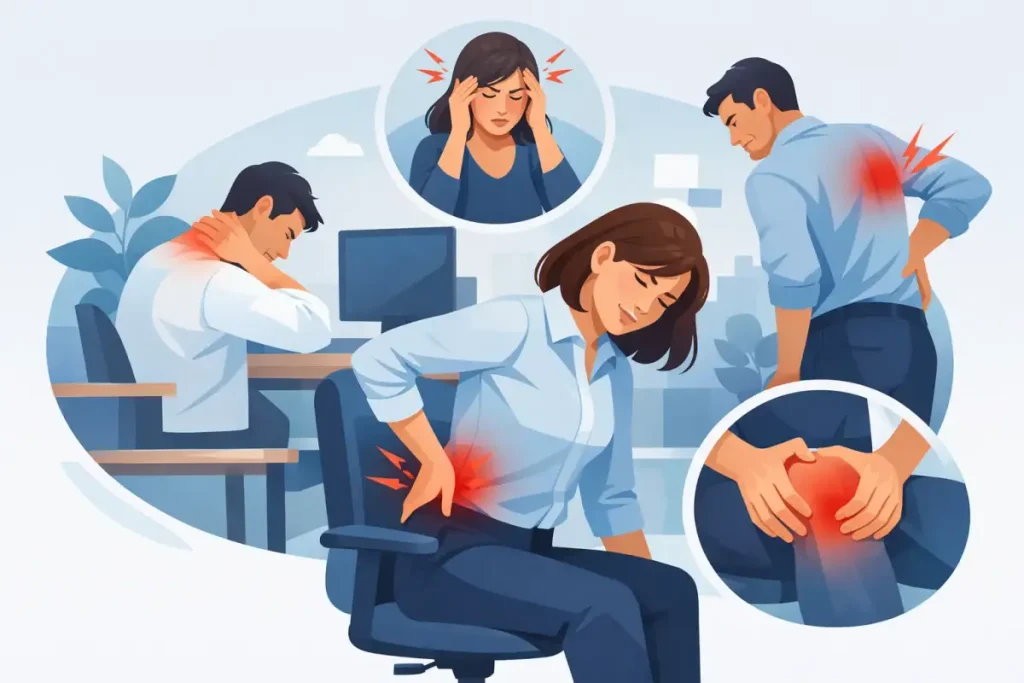
The back often doesn’t just get in touch after work. It pulls between the shoulder blades, the neck gets hard, the lower back feels blocked when you get up. Resolving back pain in the office does not therefore mean exercising particularly motivated once a week. It means changing everyday work in such a way that tension doesn’t even get stuck for hours.
The good news: You don’t need a gym in the office or complicated self-therapy for this. Small, consistent decisions in sitting posture, movement and regeneration make a noticeable difference. And if the voltage is already low, the solution can also be direct and time-efficient.
Why office work puts so much strain on the back
Sitting is not fundamentally bad. It becomes problematic if the body stays in the same position for hours. Even an ergonomic chair cannot prevent tension if you remain immobile in it. Muscles are strained on one side, blood circulation decreases and the body goes into a kind of protective tension.
In addition, there is the typical screen mode: the head moves forward, the shoulders pull up, the hands work tensely on the mouse and keyboard. This posture puts a strain on the neck, upper back muscles and often also the lower back. Stress increases the effect. Anyone who works concentrated, breathes shallowly and constantly reacts to notifications, unconsciously keeps more tension in the body.
So it’s not just about the office chair. Back pain often arises from the interplay of posture, lack of position changes, mental pressure and too little real recovery.
1. Adjust the workplace to your body
Ergonomics only work if it suits you. The screen should stand so that your gaze falls straight or slightly down to the top of the screen. If you have to permanently lift your head or push it forward, the neck becomes the holding apparatus for your working day.
Adjust the chair so that both feet are stable on the floor and the knees are approximately at waist level or slightly below. The back needs contact with the backrest, but not a rigid forced position. If they sit too low, the pelvis tilts backwards. If they are too high, pressure will develop in the thighs and they will lose secure ground contact.
The arms also deserve attention: the keyboard and mouse belong close to the body. If you keep reaching forward, shoulders and upper back work against the distance all day. A good attitude doesn’t take away back pain, but it prevents every email from building up new tension.
2. Do not move movement to lunch break
The most effective counterpoint to rigid sitting is regular movement. Not intense, but often. Get up briefly every 30 to 45 minutes at the latest. Get water, make a phone call while walking or switch to a bar table for two minutes.
These mini interruptions work because they give the body new stimuli. The muscles do not have to harden completely before it is allowed to move again. Anyone who sits for eight hours and stretches ten minutes in the evening is doing something good. If you keep moving during the day, you reduce the load much earlier.
A fixed trigger is practical: after each completed work step, after an online meeting or when sending an important message, you get up once. In this way, movement does not become a resolution that one forgets, but part of its routine.
3. Actively open the upper back
Many office tensions don’t sit right where they hurt. If the shoulders pull forward, the upper back loses mobility. The chest muscles feel shortened, while the muscles between the shoulder blades must work permanently.
Sit upright, let your shoulders sink deliberately and gently guide the shoulder blades back down. Hold this position for two calm breaths and release again. Repeat this several times a day without pressing with force. It’s not about a military attitude, but about a counter-impulse to collapse.
A short change of position also helps: fold hands behind your head, open your elbows wide and lift your chest. If it shows a pleasant pull, this is usually a sign that the body missed exactly this movement. Pungent pain, on the other hand, is a stop signal.
4. Relieve the lower back with pelvic movement
When sitting for a long time, the pelvis often becomes immobile. As a result, the lower back feels stiff or sensitive when you get up. A simple movement in the workplace: sit upright and slowly tilt the pelvis forward and backwards. The back is slightly hollow and then slightly round. Perform the movement calmly and in a controlled manner.
This small mobilization does not replace a targeted examination for severe symptoms. However, it can help to interrupt the rigid sitting position. Especially after long meetings, car journeys or concentrated work phases, it gives the lower back room to move.
If you have a height-adjustable table, you shouldn’t stand all day. Standing for a long time can also tire. The advantage lies in the alternation: sometimes sit, sometimes stand, sometimes go. The best job is rarely a perfect posture, but a workplace that allows for different postures.
5. Remove stress from the body
A full calendar often shows up first in shoulders, jaws and breathing. if you work under time pressure, you may hold your breath or just breathe superficially. This signals the nervous system to alert and keeps the body tense.
Take 60 seconds before an important conversation or between two appointments. Place both feet on the floor, let your shoulders loose, and intentionally exhale longer than in. This short break is not a wellness ritual without any effect. It interrupts the stress mode and creates the condition that muscles can even let go.
It is particularly worthwhile to look at the working method, especially for recurring back pain. Is the pain stronger on days with many meetings? After conflicts? for deadlines? Then not only does the back need more attention, but also their break and stress limits.
6. Regenerate in a targeted manner when the voltage is stuck
Some tension can be significantly reduced by better habits. However, if the back stays hard again and again despite movement, ergonomic workplace and breaks, a targeted regeneration application can make sense. The decisive factor is that it fits into a full everyday life and does not require more organization.
Wundermassage in Zurich for this on a non-contact application with electromagnetic pulses. It takes place fully clothed and is on short sessions designed from about 10 to 20 minutes. For people who find manual treatments uncomfortable or have little time, this can be an uncomplicated addition to their own exercise routine.
Don’t expect miracles from a single measure. Permanent relief usually arises when acute regeneration and an active everyday work come together. This is exactly the difference between a short relief and a routine that puts less strain on your back in the long term.
7. Take warning signals seriously
Not every back pain is a typical office tension. You should have symptoms checked by a doctor after an accident, sudden severe pain, feelings of numbness, symptoms of paralysis, problems with bladder or intestines and pain with fever or unexplained weight loss. Even if the pain increases permanently or wakes up regularly at night, a medical assessment is the right next step.
In the case of usual, stress-dependent tension, on the other hand, the following applies: Do not wait until the body forces you to take a long break. The sooner you interrupt sitting times, adjust your workplace appropriately and actively plan relaxation, the better the chances that the pulling will not become permanent.
Your back does not require perfect everyday office life. He needs regular exercise, less constant tension and moments when he can really let go. Start today with a short waking up, a conscious breath, and an attitude at your workplace that finally fits your body.
The suitability is discussed individually before use. Results can vary. Miracle massage does not replace a medical diagnosis or prescribed treatment. The application is not carried out during pregnancy. Miracle Massage · Zurich

